Applied Net 2026 just wrapped up, and one of the things I love about the conference is hearing directly from other agencies about what they are doing and where they see the industry heading.
One thing became clear from those conversations: AI has officially moved into the independent agency. Today, it’s helping agencies draft emails, summarize documents and analyze information. Soon, it will complete work across agency management systems and through a growing list of insurance-specific products.
The biggest opportunity with AI is helping agencies spend less time processing tasks and more time advising clients, solving problems and building relationships.
With more AI tools becoming available, agencies face an important question: Should your agency use Microsoft Copilot, ChatGPT, Claude or an insurance-specific assistant?
The answer is not necessarily one or the other. To make a smart decision, agencies need to look beyond the name of the AI model and consider the business platform surrounding it.
Start with the Platform, Not Just the Model
The first thing agencies need to understand is the difference between an AI model and the business platform through which that model is used.
Models such as GPT from OpenAI and Claude from Anthropic provide reasoning capabilities. Platforms like Microsoft Copilot, ChatGPT Enterprise, Claude Enterprise and insurance-specific products provide the working environment surrounding the model. That platform may determine what business information the AI can access, which security and permission controls apply, whether activity can be monitored or audited, how long information is retained and which applications and systems are connected.
Think of the AI model as the engine and the platform as the vehicle. Two vehicles may have similar engines, but they can still have different controls, safety features, capabilities and destinations.
The model matters, but so does everything surrounding it.
Copilot, ChatGPT and Claude Are Not Always Separate Choices
Depending on the Microsoft Copilot product, licensing, permissions and agency configuration, users may be able to choose from available models or use an automatic setting that selects a model for the task.
Selecting a model within Copilot does not place an employee in that provider’s standalone application. The selected model may help generate the response, while Copilot remains the business platform that governs the user experience, connected information and applicable controls.
This is similar to selecting a carrier for a particular risk. The carrier matters, but so do the agency’s workflows, documentation, permissions and review procedures surrounding the placement.
Rather than asking, “Which model do we like best?” an agency should ask, “Which approved platform should employees use for this work, and what protections does that platform provide?”
When Microsoft Copilot Makes Sense
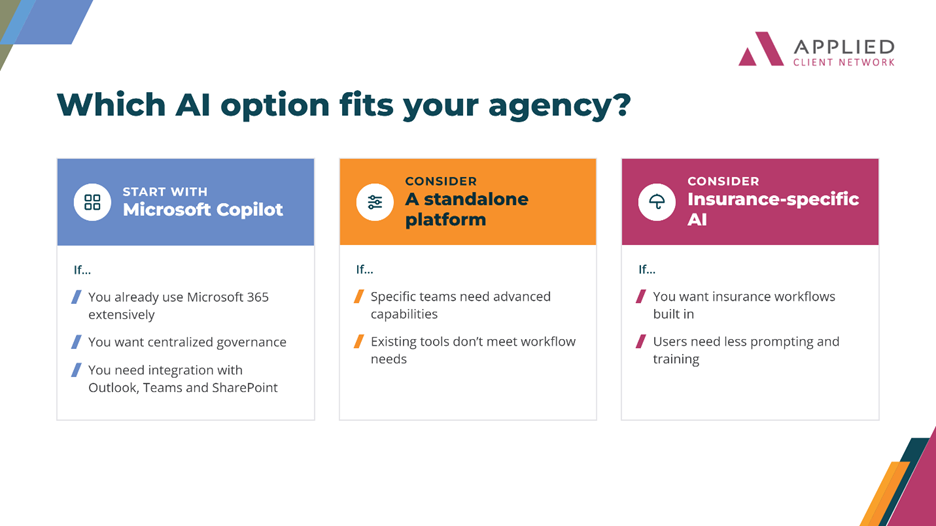
For agencies already operating in Microsoft 365, Copilot can be a natural fit because it works within the environment where many employees spend their day.
Depending on licensing, configuration and permissions, Copilot can help summarize emails, draft responses, create presentations, compare documents, analyze spreadsheets and find information an employee is already permitted to access.
Copilot’s advantage is not simply the AI model it uses. Its value comes from working within the Microsoft environment and using the identity, permissions, security controls and configurations the agency has established.
When a Standalone AI Platform May Make Sense
Purchasing a business or enterprise plan from OpenAI or Anthropic gives an agency access to that provider’s business workspace. These offerings include security, privacy and administrative controls that the agency must review and configure for its specific needs.
A standalone platform may make sense when certain employees need capabilities or workflows better served by a separate product.
However, a free or personal AI account should not be treated as equivalent to an agency-managed business account. Business and consumer products can have different contracts, privacy protections, administrative controls, retention settings and data-handling terms.
Before purchasing another platform, an agency should determine whether it fills a real need or simply duplicates capabilities already available within an approved environment. An agency should also weigh the added value against the cost and governance burden of rolling out another tool.
Where Insurance-Specific AI Fits
Insurance-specific AI products may use familiar models such as GPT or Claude on the back end. Their distinction lies in the insurance knowledge, specialized instructions, integrations and predefined workflows that vendors build around those models.
Ask Ellie from Total CSR, for example, focuses on insurance knowledge, training, marketing, customer service and professional development. Coverflow’s AI Assistant supports insurance-focused activities such as prospecting, insurance and coverage questions, proposal generation and coverage comparisons.
In my experience, insurance-specific tools often require less explanation because the insurance context has already been added. Instead of teaching a general-purpose tool what an account manager does, a specialized product may already understand the terminology, role and intended workflow.
That context can make these tools easier to use, but agencies still need to evaluate the vendor’s security, data retention, information sources, integrations and contractual terms.
Practical Tips for Any AI Tool
Regardless of the platform or model, a few consistent practices can make AI use safer and more effective:
- Use approved tools. Client or agency information should never be entered into an unapproved consumer AI service. Use platforms reviewed and configured for the agency’s security and compliance needs.
- Give AI a clear assignment. Include the objective, audience, context, tone and desired format. “Write an email” will produce a different result than “Draft a friendly email explaining why updated payroll information is needed before renewal.”
- Ask AI to identify uncertainty. Have the tool point out assumptions, missing information and anything that still needs to be verified.
- Verify important information. A polished answer can still be incomplete, outdated or confidently wrong.
- Keep a professional in the loop. AI can draft, summarize, compare and recommend, but it should not make the final decision. A knowledgeable employee should review the output, apply professional experience and remain accountable.
Build a Portfolio, Not a Collection
Every agency is different. We use different vendors, support different markets and have different operational needs. Each agency will likely use its own combination of AI tools.
One agency may use Copilot and one insurance-specific product, while another may need additional platforms for particular employees or workflows. The goal is not to collect AI subscriptions. Too many overlapping tools can increase costs, confuse employees and make governance more difficult.
Start with the work the agency wants to improve. Look for real bottlenecks and activities taking the most time from your team. Then review the available platforms, understand which models and capabilities are offered within each one and determine which combination best fits your agency.
AI gives us an opportunity to accomplish more, but its greatest value may be the time it gives back to our people. Used responsibly, it can help insurance professionals spend less time processing tasks and more time applying their expertise, advising clients and building relationships.
AI should not remove our professionals from the work. It should return them to the work where they provide the greatest value.