On July 1, 2026, Ontario, Canada, introduced significant changes to its auto insurance regulation system. The reform gave consumers more choice by making several accident benefits — coverages that provide financial support and assistance to people injured in an automobile accident — optional rather than automatically included in every policy.
For agencies, the change was about much more than updating forms or learning new rules. Agents needed to confidently explain the available options, document client decisions and ensure those conversations happened consistently across the organization. Because these discussions directly affect the protection clients choose for accident-related coverage, agencies needed a consistent approach that balanced client education, documentation and regulatory compliance.
While Ontario's Auto Insurance Reform is specific to Canada, the implementation challenge is universal.
Whether you're responding to a regulatory change, introducing a new carrier, implementing technology or redesigning a workflow, success depends on more than training. Looking back, this implementation reinforced five pillars that are critical to successful change initiatives.
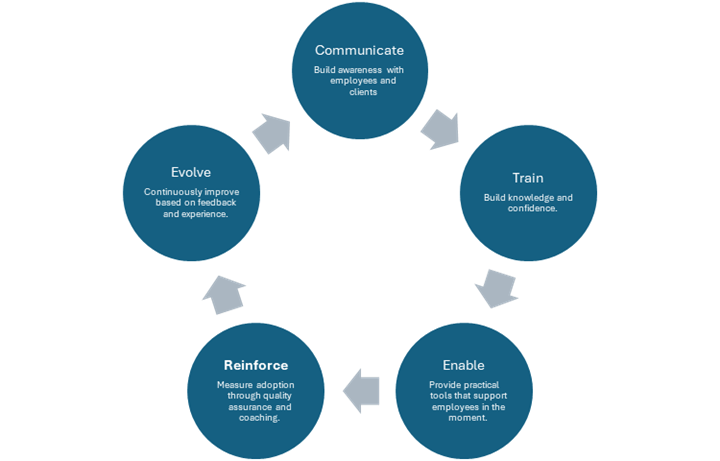
Think of these pillars as interconnected rather than sequential. Communication doesn't stop when training begins, and quality assurance doesn't start when implementation ends. Each pillar continues to support the others throughout the lifecycle of the change.
-
Communicate
Communication shouldn't be treated as a single announcement. It should be an ongoing strategy.
For Ontario's Auto Insurance Reform, communication extended well beyond employee emails. It included team meetings, live check-ins, FAQs and regular reminders to reinforce key messages throughout implementation.
We also developed client-facing communications, including awareness e-blasts, renewal letters and a dedicated landing page to help consumers understand what was changing before agent-client conversations took place.
The goal was to ensure people received the right information, through the right channel, at the right time. Different audiences need different messages, but consistent communication reduces uncertainty and builds confidence before implementation even begins.
-
Train
Training should build confidence, not simply transfer information.
With this auto reform, agents needed more than an understanding of the legislation. They needed to confidently explain new coverage choices in plain language, answer client questions and document conversations appropriately.
Initial training is only the beginning. Short, on-demand refreshers, carrier resources and real-world scenarios give teams practical ways to reinforce their knowledge as questions arise after implementation.
Ultimately, training should leave people feeling confident enough to have the conversation, not just be familiar with the process.
-
Enable
Training tells employees what to do. Enablement helps them do it consistently.
During implementation, one of our priorities was making sure agents had practical support at the moment they needed it. We created a centralized implementation playbook that included conversation guides, documentation checklists, workflows, FAQs, carrier resources and coverage reference materials to build confidence during client conversations and promote consistent documentation.
We also recognized the value of creating spaces where employees could ask questions in real time, whether through a dedicated Teams chat, office hours or regular implementation check-ins. Quick access to answers helps build confidence and keeps implementation moving forward.
The lesson applies to any agency: If employees are expected to follow a new process, ask yourself what tools they'll have in front of them while they're doing the work.
-
Reinforce
Implementation doesn't end when training is complete. That's when measurement becomes important.
As Ontario's Auto Insurance Reform continues to roll out, we're incorporating targeted checkpoints into our existing quality assurance reviews to monitor how consistently the new workflow is adopted. Rather than simply looking for errors, we're looking for trends.
- Are agents having the intended conversations?
- Are documentation expectations being met?
- Are there areas where additional coaching or clarification is needed?
Those observations help identify opportunities to reinforce the process before inconsistent habits become established, while also highlighting where workflows or supporting resources may need to be adjusted.
-
Evolve
No implementation is perfect on day one.
Planning is essential. But the true test of any implementation happens after launch, when real client conversations begin. As Ontario's Auto Insurance Reform continues to roll out, we're monitoring employee questions, quality assurance trends and feedback to determine where resources, workflows or training can be refined.
Technology is supporting that work as well. AI has helped accelerate the creation of updated conversation guides and role-play scenarios and learning materials, allowing more time to focus on coaching and continuous improvement. Any AI-generated content is reviewed by subject matter experts before being shared, ensuring it supports — not replaces — professional expertise.
Successful implementation requires a willingness to listen, adapt and improve as the organization learns.
Beyond Launch Day
Ontario's Auto Insurance Reform is still in its early stages, and like any significant change, implementation will continue to evolve as agencies learn what works well and where adjustments are needed.
Perhaps that's the biggest takeaway. Successful implementation isn't about getting everything perfect before launch. It's about creating a process that allows your organization to listen, learn and improve as the change becomes part of everyday operations.
Whether you're implementing a regulatory change, introducing a new carrier or rolling out new technology, these five pillars provide a practical framework for supporting both your teams and your clients through change.
A successful launch is important. What happens after launch is what makes the change last.